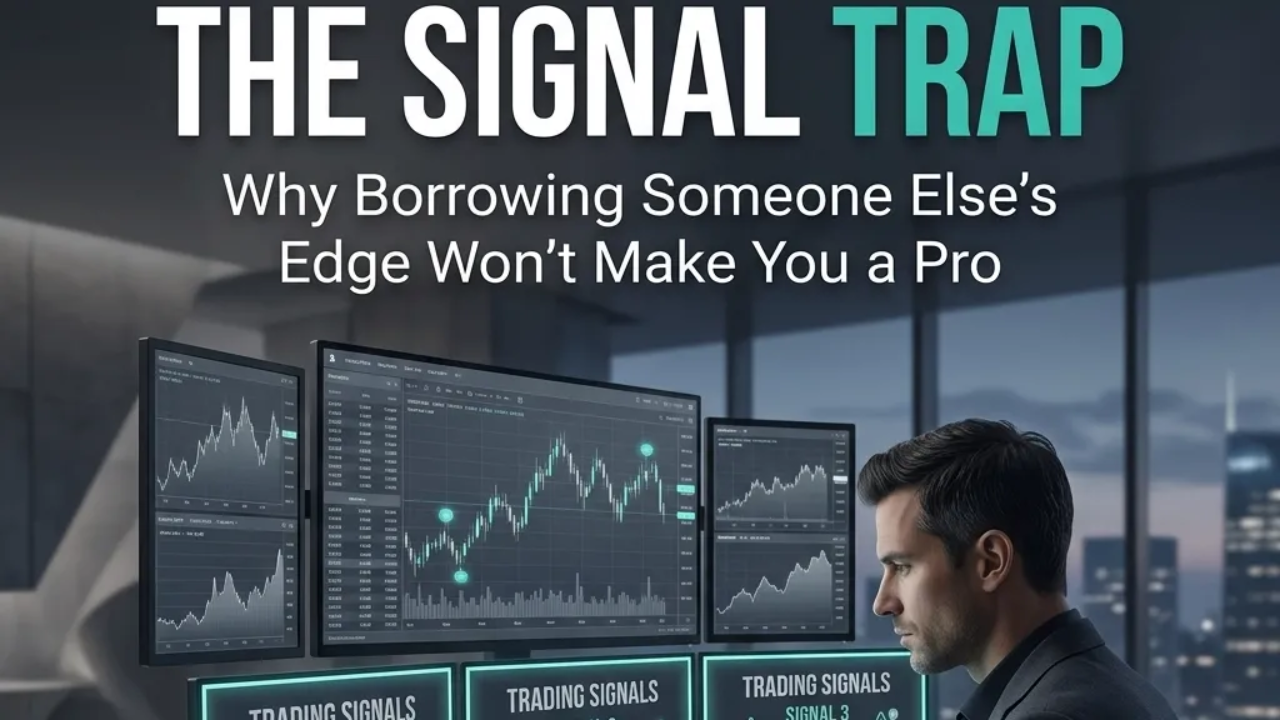
The Signal Trap
May 07, 2026You see it everywhere on social media. Flashy cars, screenshots of massive PnL statements, and the "Join my VIP signal group" link sitting right in the bio. It sounds like the perfect shortcut. Why spend years staring at charts when you can just pay someone a few bucks a month to tell you exactly when to buy and when to sell?
Here is the cold, hard truth: Following signals is the fastest way to stay a retail amateur.
At Pro Trader Desk, we don’t do "hype." We don’t do "magic indicators." And we definitely don’t do signals. If you’re looking for a guru to hold your hand and tell you what to do every morning, you’re in the wrong place. But if you want to understand how the market actually works so you can take trades with total confidence: regardless of what some guy on Telegram says: then you’re ready to grow.
Borrowing someone else’s edge is like borrowing a pair of glasses with a different prescription. It might look clear for a second, but eventually, you’re going to end up with a massive headache and a blown account.
The Mirage of the Easy Button
The appeal of signals is rooted in laziness. Most people don't actually want to be traders; they just want the money that traders make. They treat the market like a vending machine. Put in the signal, get out the profit.
But the market isn't a machine. It’s a living, breathing auction driven by institutional order flow and human emotion. When you follow a signal, you are completely blind to the "why." You don’t know why the entry was placed, why the stop loss is where it is, or why the profit target makes sense.
Without the "why," you aren't learning a process. You’re just gambling on someone else’s screen time. And here is the kicker: even if the signal provider is actually a good trader (which is rare), you still won't make money in the long run. Why? Because you don't have the conviction to sit through the drawdowns.
Why You Can’t Trade Someone Else’s Conviction
Trading is 20% strategy and 80% psychology. When you develop your own edge based on pure price action, you build conviction. You’ve seen the patterns repeat thousands of times. You understand the institutional structure. When the trade goes into a bit of drawdown: which happens to every pro: you stay calm because you know your "why."
When you’re following a signal and the trade goes into the red, panic sets in immediately.
- "Did he get it wrong this time?"
- "Should I close it early?"
- "Is the market changing?"
Because you didn't do the work, you have zero trust in the trade. You’ll end up closing the winners too early and holding the losers too long because you’re operating on borrowed confidence. Borrowed confidence is a house of cards. One bad week from the signal provider, and your "career" is over.
The Indicator Trap and the Hype Culture
Many signal groups rely on "lagging indicators." They’ll show you a chart with five different moving averages, an RSI, and other built in indicators. They make the chart look like a Christmas tree because it’s easier to sell "magic" than it is to sell "work."
At Pro Trader Desk, we strip all of that away. Real institutional traders don't look at whether the MACD crossed over the zero line. They look at price. They look at liquidity. They look at market structure.
When you clutter your screen with indicators, you are looking at what happened, not what is happening. By the time most indicators gives you a "signal," the big money has already moved the market, and you’re just the exit liquidity.
Developing Institutional-Level Structure
If you want to move from being a "signal seeker" to a "professional trader," you have to learn to read the price action and structure. This means understanding how price moves between zones of supply and demand and how to identify where the "big boys" are placing their bets.
Professional trading is about finding a repeatable process. It’s about looking at a naked chart and being able to tell a story.
- Where is the trend?
- Where is the trapped liquidity?
- Where is the high-probability entry point that offers a 3:1 or 5:1 reward-to-risk ratio?
When you master these mechanics, you don’t need call out on a live stream. You see it for yourself. You become the source of the edge, not the consumer of it.
The Danger of the "Win Rate" Myth
Signal providers love to brag about "90% win rates." In the professional world, that is a massive red flag. Most of the best traders in the world only win 40% to 50% of the time. The difference is that their winners are much, much larger than their losers.
By learning pure price action, you learn how to take "tight" entries with low risk and high upside. You learn that losing is just a business expense, not a failure of the system.
Moving From Gambling to a Professional Process
If you are currently in a signal group, do yourself a favor: leave. Take the money you’re spending on that monthly subscription and invest it in your own education.
Stop looking for the "what" and start asking "why."
- Why did price bounce at that level?
- Why did that breakout fail?
- Why is the market trending today when it was range-bound yesterday?
This is the shift from gambling to professional speculation. It’s not easy. It takes time. It takes discipline. But it is the only way to achieve actual freedom. If you are dependent on someone else for your signals, you aren't free. You’ve just traded a boss at a 9-to-5 for a boss on a trading app.
Own Your Success (and Your Failures)
The most empowering moment in a trader’s life is when they take a trade based on their own analysis, manage it according to their own rules, and book a profit. There is no feeling like it. It’s the realization that you have a skill that can feed you for the rest of your life.
Conversely, when you lose a trade that you analyzed, you can go back to the charts and see what went wrong. You can tweak your process. You can grow. When you lose on a signal, you learn nothing. You just feel cheated.
What Real Trading Looks Like
Real trading is often boring. It’s waiting for the market to come to your levels. It’s sitting on your hands when there is no setup. It’s the opposite of the high-octane "hype" you see in signal rooms.
At Pro Trader Desk, we advocate for a simple approach:
- Clean Charts: No distractions, just price.
- Strict Process: Knowing exactly what you are looking for before the market opens.
- Risk Management: Protecting your capital above all else.
- Self-Reliance: Building the skills to trade any market, at any time, on any timeframe.
Your Path Forward
If you’re tired of the signal trap, it’s time to change your approach. Stop looking for shortcuts. There are none. There is only the work, the chart, and the process.
Start by stripping the indicators off your charts. Look at the candles. Look at the highs and lows. Start noticing how price reacts at certain levels. You’ll be amazed at how much clearer the market becomes when you stop trying to find a "secret" and start looking at the obvious.
Becoming a pro trader is about taking full responsibility for every tick. No excuses, no signals, no hype. Just you and the market. That’s where the real money is made.
Are you ready to stop borrowing an edge and start building your own? The market is open every day, offering the same opportunities to everyone. The only thing that separates the pros from the amateurs is the process. Decide today which one you want to be.